
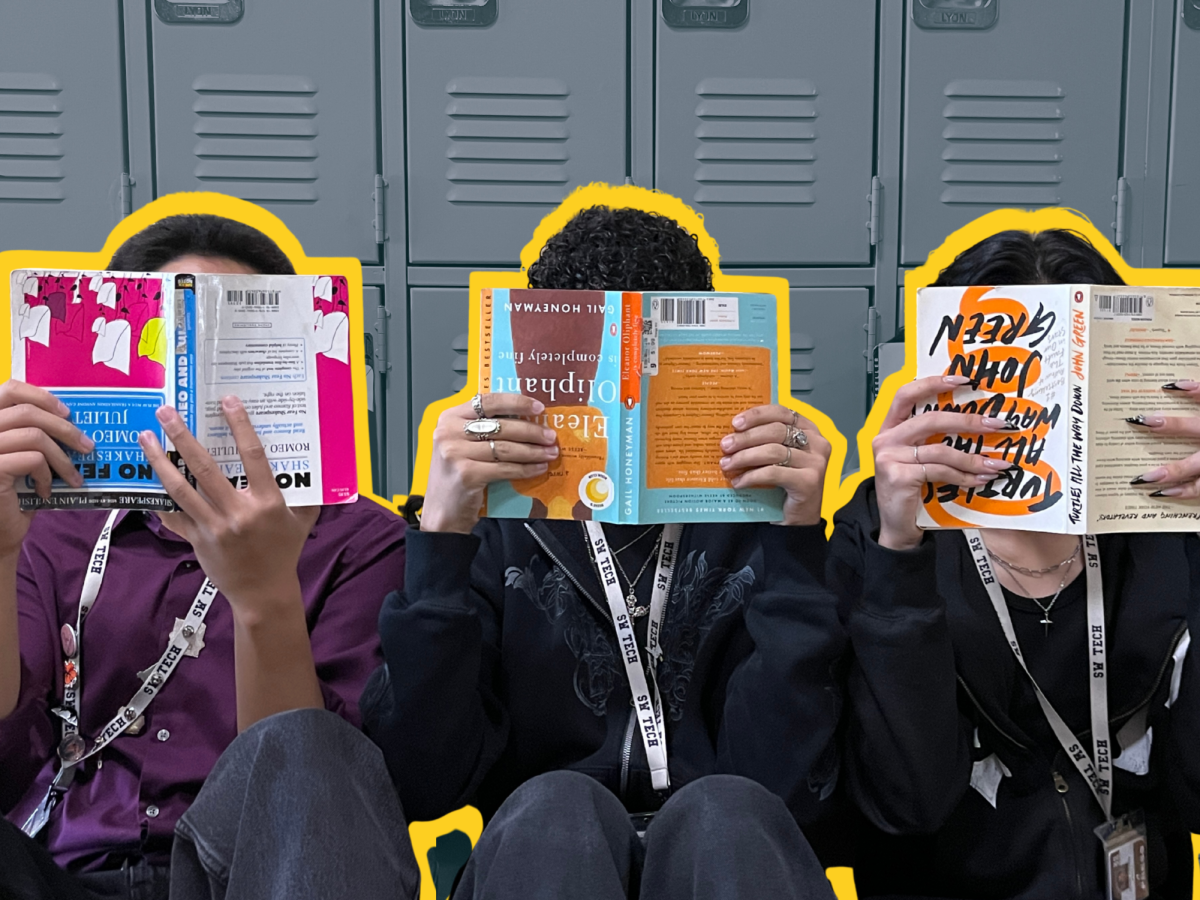
Somewhere in America, a high school student has just been assigned to read “Fahrenheit 451” by Ray Bradbury. Being eager to finish their assignment, they quickly crack open the book and begin to read.
Only to realize they can’t.
The vocabulary is confusing, simple paragraphs take up to an hour to read and they constantly need to take breaks between sentences. Frustrated and defeated, they choose to open up an AI chatbot or online summaries of the novel instead of opening up the book again, leaving the original text, ultimately, untouched.
“People see the first page of a book and there’s a lot of unknown words to them, so they’re just like: ‘I don’t think I could even understand this without searching things up’,” freshman Rebecah Ulan said. “Reading requires sitting down and actually understanding and processing the words and a big part of it is that they can’t do that, so they just don’t feel like doing it.”
This scenario, whether it’s with “Fahrenheit 451”, “The Crucible”, “1984”, or “Romeo and Juliet”, is one that’s familiar for many students. This mutual experience signifies the continuation of an ongoing trend of decreasing literacy rates in young Americans, specifically in teenagers and emerging adults.
“In class, anytime it comes to reading, everyone will always not want to read or look for a way to get around having to do it,” sophomore Nolan Pacheco said. “Most of them say that they don’t enjoy it, or they can’t read because the book is too boring.”
There are numerous factors that can be attributed to these statistics. However, one of the most cited is the decreasing attention spans of Generation Z and Alpha that stems from an overuse of social media. Generation Z’s attention span is reported to be around eight seconds long, which poses a challenge when they have to read a book for an English class. Attention spans are directly linked to a person’s reading stamina, which is the ability to focus on a piece of writing for extended periods of time without losing focus.
“It’s affected the way that we teach and try to keep students engaged,” English teacher Maritza De La Fuente said. “It’s more, for me, performance now than just a lecture. You can’t lecture traditionally a lot with freshmen, it doesn’t work. A lot of that comes into it kinesthetically and I try to be like: can I get them up? Can we be moving? Can I keep their attention spans?”
While many young people aren’t reading full-length novels, they are interacting with more short form text than ever before. Text from social media posts, comments, news headlines and advertisements floods our brains every day because of the rise of the internet. The average person spends around two hours and 24 minutes a day on social media, almost guaranteeing that they’re exposed to a barrage of text from different sources.
Some might think this could act as a substitute for daily reading, but the issue arises when this becomes the sole source of erudition. This constant exposure to short-form text does not necessarily translate into the deep, sustained learning and thinking that takes place when reading a novel.
“Of course, I’m still reading on social media, but also I feel like it’s because I need to do it, not because I want to do it,” Ulan said. “Because that’s how you get across to people, it’s like how you text people, you have to do it. But with reading a book, you either pick it up yourself or school tells you to do it … I don’t really see people reading outside of class.”
This phenomenon is exacerbated by the standardized testing and curricula implemented in schools. As national tests like the SAT and ACT have English and reading sections centered around short form texts—such as poetry, articles and prose selections—the material taught in English classrooms also focus on analyzing short pieces of writing rather than delving into entire books.
“All of the materials that were given to us this year were based on short stories, essays, articles, short format text,” English 11 teacher Jacob Hill said. “Last year, we were given a directive, even, to spend less time reading novels in the classroom. I think that overhead, we’re being directed to teach shorter texts … However, novels are great because there’s a whole narrative, right? You’re able to dive deeper. It can be complex or there can be a lot more lore and you don’t get the ability to break down or learn the skills to break down any long form media without models like that.”
The overall negative stigma around reading among adolescents also contributes to a lack of interest in novels.
“People think that books are this really academic thing, so they don’t think that reading will appeal to them,” freshman Mya Mapa said. “When I first started reading, I had trouble finding what I liked. So I think advertising books to people my age would be helpful. Maybe by using more of the terms that we use, more of the lingo, or the vocabulary we use will help people read more.”
Students are more likely to turn to using artificial intelligence (AI) technology to complete their schoolwork, as they do not possess the necessary skills to read proficiently. Currently, half of high school students are using AI to brainstorm ideas, edit or revise their essays. In English classes, the tool can further be exploited to generate chapter summaries of books or to explain the various themes of a piece of literature without the user actually engaging in any critical thought.
“Teachers all around the world are trying to combat this technological laziness,” De La Fuente said. “Everyone relies on these different tools and it’s made kids give up. They’re not even trying to use the skills that we teach them and then they’re losing them, which is leading to this crisis. So I hope that with more pushback, more regulations around AI and different apps, more of us will try to keep the original skills that we’ve worked on.”
Take the opening passage of Jane Austen’s “Pride and Prejudice” compared to an abridged version generated by ChatGPT:
While the simplified version may contain the main ideas of the text, it does not include any of Austen’s original prose and therefore lacks the wit and style that’s characteristic of her writing. Simply reading summaries of text often leads to a shallow understanding of written works, as they strip away much of the context and nuance of the content and therefore isn’t typically sufficient to understand the complete meaning of a novel.
“Even though AI has taken over everything, the experience is just better when you read,” Ulan said. “Because, of course you get the main plot, but you don’t get the quotes or the feelings out of the book. My favorite part of reading is the build up to everything that happens and a summary doesn’t tell you why that specific thing happened or why an author did something.”
When students aren’t able to build foundational literacy skills they eventually fall behind in all of their classes, even if they aren’t traditionally focused in the study of language or literature. All subjects, whether it be English, Calculus or Biology, require some form of reading to gain foundational knowledge.
“We can go over something in class and then you ask [students] an hour later and it’s like it never happened,” De La Fuente said. “It’s the basics: the grammar, the capitalization, the periods. These things, I know for a fact, they’re learning these things in elementary, but I feel like they have struggled with that. I was just sitting in a lecture and the majority of the students were like: ‘What is that? What’s an adjective?’. And I’m not talking about appositives or prepositions right now. I’m talking about nouns, verbs, adverbs. The basics.”
Young adults are now leaving high school and going out into the workforce without these base level abilities. As of 2023, 25% of young adults aged 16-24 in America were functionally illiterate, meaning that while they’re able to read and write basic sentences, they’re unable to manage basic tasks such as reading prescription labels or navigating the internet.
“Everything will crumble,” De La Fuente said. “People will be taken advantage of. These are your doctors, your nurses, your lawyers. Would you want a doctor who can’t comprehend how to read a medical chart and relies on AI that is very often wrong? We just let our country go illiterate and people just kind of ignore the crisis.”
This ultimately makes these young adults more susceptible to the spread of misinformation online, as people are not practicing the fundamental skills of media or digital literacy in their day to day lives. Without reading, a crucial building block of critical thinking, people begin to think less and less about the information that’s being presented to them and take it at face value.
“I can see it worsening,” Hill said. “It’s scary … but I think that helping kids find stories that they resonate with and finding stories that represent the youth is the biggest key, because if they’re engaged in something that represents them, or if it’s something that they’re interested in, that’s the best way to engage with literature. And it will lead to them making time for it and building better habits.”
To combat this, educators have returned to more analog forms of English learning and abstaining from using technology. This includes providing paperback copies of books for students to use, which prevents them from copying the text into an AI chatbot and having students hand write assignments rather than type them.
However, this method may not be sustainable for schools with lower budgets, as buying class sets of novels can prove to be an expensive undertaking. The average paperback book sells for around $10-20; multiply that by 30 kids per class for 6 different class periods and a set of books for an entire year can easily cost thousands of dollars.

“In my class, the entire drafting process is handwritten,” Hill said. “So that when it comes time to type up the essay, you can show me that you have the skills to actually write this. AI has definitely adapted how we teach and work in the English department. Going back to pen and paper has been the biggest solution yet.”
While people have their doubts about the future of literacy in America, many educators continue to remain hopeful about the outlook.
“I think the moment we limit the technology, and that’s coming from a tech lover, I think that’s when you’ll start to see the numbers go back up,” De La Fuente said. “The kids will be all right.”
Although social media has contributed to the deterioration of attention spans, it’s also allowed for new audiences to find literature. Communities like BookTok and the popularization of trends like the “performative male” have given new life to the art form, increasing awareness to different genres and authors and bringing reading to an entirely new generation.
“People think [books] are boring because they’re longer, the words are more advanced and they’re generally less entertaining because they’re less relatable to modern people,” Pacheco said. “It’s important to see how language evolved over time and how English and writing was in different time periods by reading different books, because we wouldn’t be anywhere without them.”