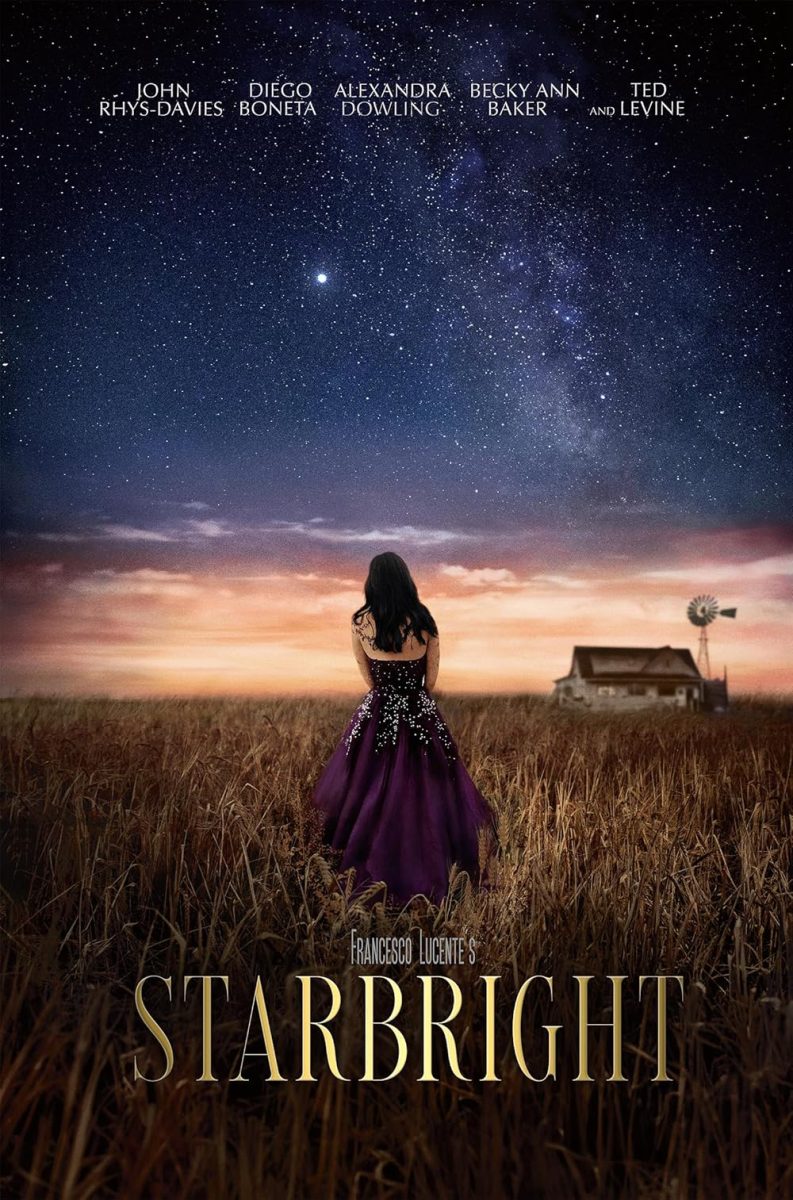
Under the dim glow of an eclipse, the sky in “Starbright” quite literally cracks open. A streak of light crashes into Aisling’s (Alexandra Dowling) quiet farm, and when she steps into the field, she finds a tiny, glowing star flickering inside a crater. It’s a strong, almost storybook image, especially when Raphael (John Rhys-Davies), who is inspired by the Christian-based archangel of the same name, appears and places the living light into a locket over her heart. For a moment, the film feels like it’s about to deliver something intimate and magical. But as the story unfolds, that sense of wonder gives way to something much more familiar.
Aisling is set up as a classic coming-of-age protagonist: an orphan on a worn-down farm, longing for something beyond her small-town life. When she’s suddenly chosen to protect the star, the film positions this as the start of her transformation. The problem is how quickly that shift happens. One moment, she is hesitant and unsure, and the next, she is fully committed to risking everything, without enough scenes in between to show that intense and complex growth. The decision feels less like a turning point and more like a requirement of the plot.
The premise itself leans heavily on ideas audiences have already seen. A magical object with immense power, a chosen guardian, and a group of pursuers chasing it down closely resembles the structure of “Percy Jackson: Sea of Monsters,” where characters move from one location to another, protecting something valuable while facing repeated threats. In “Starbright,” this shows up in the group’s constant escape from Peter, Martin, and Nick, with each encounter feeling similar to the last rather than building tension in new ways.
Even the emotional core of the story feels borrowed. The idea that the star represents hope and belief echoes “Wish,” where the star directly connects to people’s dreams. But while “Wish” gives its star personality and interaction, “Starbright” keeps its version mostly passive. Aside from glowing brighter in certain moments, it rarely influences scenes in a way that deepens the story or Aisling’s connection to it.
Character development is where these issues become most noticeable. Aisling is meant to anchor the film, but much of her personality is told rather than shown. Her desire for adventure is introduced early on at the farm with her grandparents, Bud and Teresa, yet once the journey begins, that internal conflict fades into the background. Instead of seeing her wrestle with fear, responsibility or loss, the film moves her from scene to scene without fully exploring those emotions.
Raphael, who enters as a mysterious, almost celestial figure, adding intrigue to the story. His introduction, appearing during the eclipse and entrusting Aisling with the star is one of the film’s more compelling moments. However, as the story progresses, his role becomes less defined. He shifts from being an important guide to a background presence, without the depth or complexity that his character seems to promise.

Joshua (Diego Boneta), the stranger who rescues Aisling and Raphael from, is another missed opportunity. His introduction during their escape from the criminals suggests he will bring emotional or narrative weight to the group. Instead, he largely serves as support, helping them move forward physically but not contributing much to the story’s emotional stakes.
In stronger coming-of-age films such as “The Perks of Being a Wallflower”, character growth is built through specific, personal moments, conversations, relationships and setbacks that accumulate over time. In “Starbright,” those kinds of moments are limited. As a result, the characters feel more like roles within a story than fully realized people.
Visually, the film shows flashes of what it could have been. The star itself is easily the highlight, especially in the scene where it rests in Aisling’s locket, casting a soft glow across her face in otherwise dark surroundings. There is also a brief moment during their journey where its light stretches across the landscape, creating a sense of scale and beauty that the rest of the film rarely matches.
Outside of those moments, however, the world feels small. The farm, the roads and the spaces the characters move through lack distinct detail, making the journey feel less like an adventure and more like a series of similar locations. This limits the sense of immersion and makes the story’s stakes feel less expansive.
The biggest issue is that “Starbright” never pushes beyond its influences. The falling star, the message of hope, the chase structure, and the found group dynamic are all familiar elements. Films like “Bridge to Terabithia” succeed because they ground their fantasy in deeply personal relationships, while “Starbright” keeps its focus broader and less specific. It follows the expected path, from discovery to escape to resolution, without adding meaningful surprises along the way.
Some moments stand out, especially the opening eclipse and the first discovery of the star. But by the time the film reaches its conclusion, those moments feel distant. The ending resolves quickly and predictably, leaning into its message about hope without fully earning it.
Starbright begins with an image that suggests something powerful: a small light in a vast darkness, full of possibility. By the end, that image still lingers, not because of what the film did with it, but because of what it never quite became.