From petty pranks to total disaster, when the world’s nastiest duo strikes, even revenge can get messy. “The Twits” is based on Roald Dahl’s 1980s children’s book about a “terrible” couple, Mr. and Mrs. Twit, who spend their time tormenting one another and their pet monkeys with pranks. In this new screenplay, however, it introduces the people of Triperot and the Twits’ twisted theme park, Twitlandia, built on filth, rotten rides, and monkey tears.
Dahl, author of Charlie and the Chocolate Factory and Matilda, is known for his quirky language, dark humor, and lessons about greed. The Twits especially reflects his focus on the consequences of evil, yet the film fails to touch on these subjects. By rarely implementing any of said themes or tones into the movie, it strays from the premise of the original story, leaving the audience longing for more of the witty humor and wickedness that characterized the Twits.
This chaotic tale is depicted through the perspective of Pippa (Emilia Clarke), a calm, spirited firefly who lives in the beard of Mr. Twit (Johnny Vegas). Pippa recounts the saga between Mr. Twit and Mrs. Twit (Margo Martindale), who are in conflict with the town of Triperot, but more specifically, orphans Beesha (Maitreyi Ramakrishnan) and Bubsy (Ryan Anderson Lopez). It all starts when the Twits’ amusement park, Twitlandia, is shut down, and out of vengeance, the Twits flood Triperot with hot dog meat. This event causes emotional turmoil throughout communities in the town, such as the orphanage, which is deemed as contaminated and causes a halt to adoption. From then on, Beesha and Bubsy embark on stopping the Twits from harming and taking over the town with the help of the Muggle-Wump family. The family consists of Mary Muggle-Wump (Natalie Portman), Marty Muggle-Wump (Timothy Simons), and Mandy Muggle-Wump (Israa Zainab), who were kidnapped by the Twits from Loompaland and used as energy sources to power Twitlandia.
Compared to Dahl’s book, the movie differs greatly beyond the original characters and plot. Many of Netflix’s animated originals have an underwhelming amount of animation and an overwhelming amount of cliche, grotesque humor meant to be a form of political commentary, and that still rings true in The Twits. By adding original songs by David Byrne, expanding backstories, relocating the setting from England to the American town of Triperot, and forcing a series of cliché jokes, the film departs from the book’s straightforward dark comedy, which includes concepts of death and illness. Specifically, the humor is more exaggerated and chaotic, relying heavily on bodily jokes and sarcastic gags, which contrasts sharply with the book’s clever, ironic pranks and subtle mischief. While these changes give the film a bolder, modern edge, it also risks overshadowing the charm and wit that made the original story timeless.
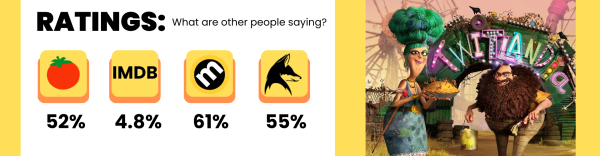
Fortunately, the visuals in this movie employ a messy and textured style to convey messages about deceptive appearances, political commentary, and corruption. By doing so, the film’s intention to portray unappealing characteristics in the setting and antagonists both repels and attracts the audience, which can be seen as a tribute to Dahl’s original story while maintaining its modern focal point by including diversity through the characters.
The overall premise of this movie is to reprise the original story, but its intentions were not executed well. The concept of the movie deviates far from the original story, as it includes frequent themes of social commentary, instead of corruption and evil intent. That is to say, the book has a straightforward emphasis on the consequences that will happen to evil people, whereas the movie looks into how the abuse of power will have consequences. Rather than seeing the Twits at their fullest potential, they are antagonized and soon rise to power. This only caused me to be reminded of political events going on today and how political disputes occur, rather than this movie being an outlet for dark humor and a take on the true spirit of the Twits.