
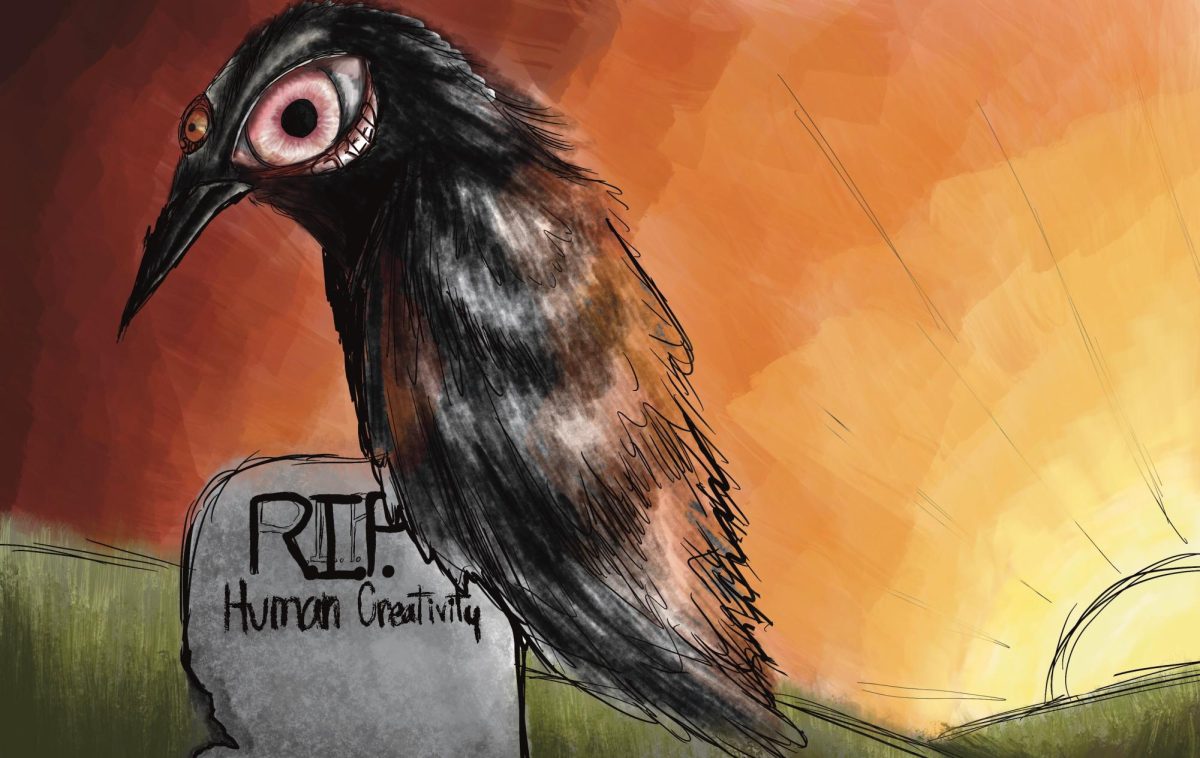
It’s a Friday night, and a group of friends is looking for a fun way to spend their time. Going to the mall and catching a movie has been a staple of teenage life for decades; however, once there, the group finds, to their disappointment, that almost every movie showing is either a sequel or a remake. This phenomenon is not restricted to the movie industry alone. An apparent lack of creativity can be found in almost every aspect of our society today, which we believe to be detrimental both to the media itself and to those consuming and creating it.
Original thought has always been something that people strive for. Now, it seems to be avoided. As the world increasingly prioritizes convenience, repetition feels like a safety net. However, remixing the same ideas comes with a cost: it discourages creativity. As society continues to rely on recycled ideas, the value of unique perspectives, individual thinking and creativity diminishes.
Aside from convenience, lack of creativity could be attributed to a fear of failure. Creating something entirely unique takes a lot of confidence, and the ability to accept rejection is a skill artists are taught early on. It is far less risky to recycle an older idea which has proved itself successful, as it supposedly poses a lower chance of failure. This mindset encourages creators to play it safe rather than take creative risks, ultimately stopping originality.
Students in schools have been especially affected by this creativity famine. With premade templates for infographics and slideshows easily accessible, projects that once required days of creative brainstorming can now be completed in a single class period. In the past, teachers could assign more open-ended projects, allowing students to interpret the assignment freely and take creative liberties in making something entirely their own.
Today, students struggle with creative projects, often requiring teachers to provide detailed lists of ideas or relying on generative AI to brainstorm ideas for them. In some cases, students resort to plagiarism rather than developing original ideas. This can be attributed in part to a fear of failure, as students hesitate to take creative risks or worry their ideas will be judged as inadequate. In turn, students will rely on technology to do the work for them, hindering creativity and limiting unique thoughts.
This is also evident in larger institutions, particularly in the film industry. Studios such as Disney and Universal Pictures were once praised for their creativity and originality, but in recent years, these companies have lost loyal audiences due to their reliance on remakes and sequels rather than original content. In 2025, Disney’s live-action remake of Snow White, starring Rachel Zegler, not only received hate online, but also bombed at the box office, further demonstrating audience fatigue with recycled ideas.
On the other hand, when Sony released the original movie musical, K-Pop Demon Hunters, a project that took almost ten years to make, the film was an almost instant success, with the most popular song, “Golden,” topping charts worldwide. Sony’s success, when compared to Disney’s recent failures, demonstrates how new ideas can captivate audiences and gain support.
While the recycling of ideas in entertainment is an idea generally criticized, one industry appears to do it successfully: Broadway. Movies such as Beetlejuice, The Lion King, and Mamma Mia, as well as novels, such as Wicked, Les Misérables, and The Phantom of the Opera, have inspired some of the most popular Broadway productions, drawing audiences to the theaters year after year. Unlike film remakes, these adaptations work to improve upon their source material.
A modern, specific example of this is Wicked, one of the longest-running and most popular shows on Broadway. Many fans prefer the play over the original novel, showing that, while musical theater does recycle old ideas, playwrights can take creative liberties to produce work that is familiar and unique, allowing Broadway to honor original stories while encouraging innovation.
Creativity is not limited to entertainment and the arts; it plays a crucial role in fields such as politics, though it may not be as obvious. During his campaign for mayor of New York City, Zohran Mamdani created a successful digital campaign emphasizing both communication and mobilization to voters. By incorporating humor and personal culture into his online presence, Mamdani connects with voters in unconventional ways. One notable example of this is when he jumped into the ocean as a metaphor for “freezing the rent,” using his creativity to demonstrate commitment to his residents. His victory over Andrew Cuomo highlights how originality and adaptability strengthened public engagement and connected people.
The decline in creativity is an important issue that impacts everyone. From moviegoers to students to the general public, creativity shapes how society functions and develops. Whether working on a school project, directing a film, writing a play, or planning a new political campaign, original thought drives progress. To move forward, society must overcome its fear of failure and recognize that creativity is a necessity. While repetition might provide a safety net, creativity is the building block to a better and more innovative future.


Kitty Alexander • Feb 16, 2026 at
This reason is honestly why I really only watch foreign movies these days. Great article!!