
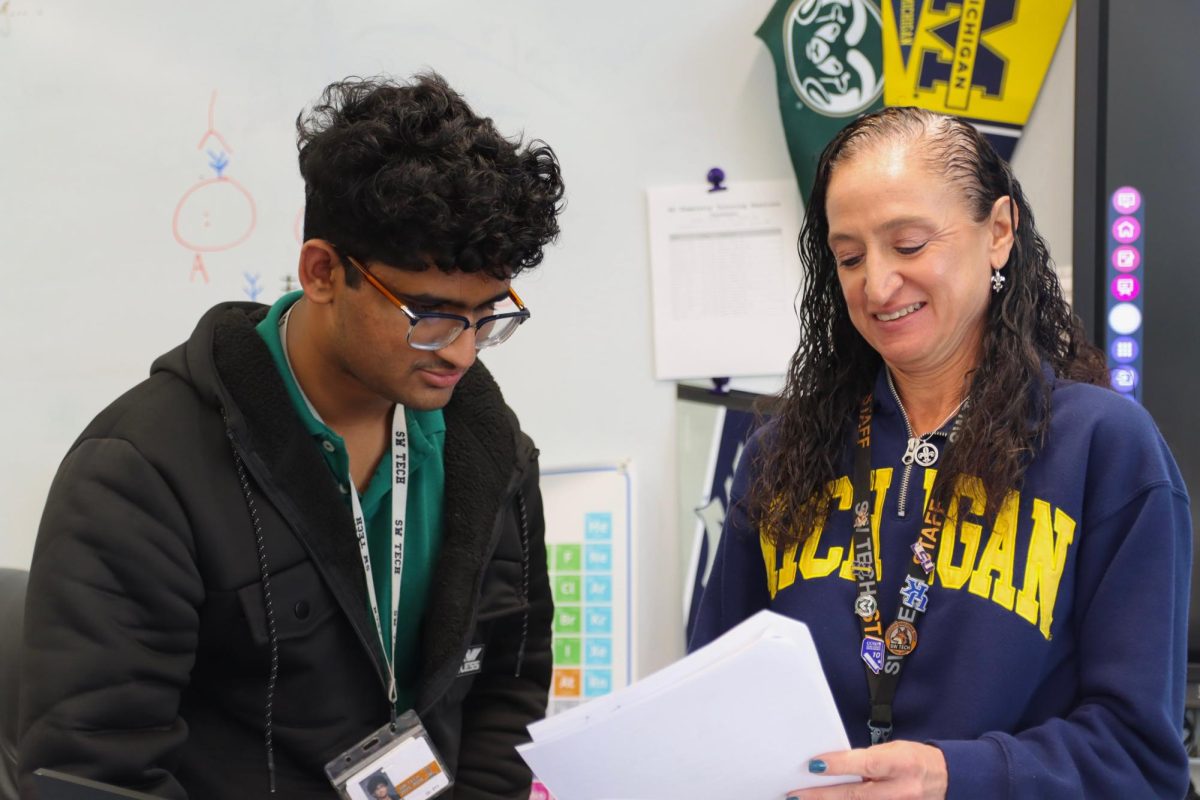
With gloves on and tools at the ready, science teacher Dr. Mary Breslin prepares to guide her class through another hands-on lab. Having led research labs for well over a decade, Breslin has her fair share of experience running experiments far more complex than these.
For Breslin, a lifelong interest in science began long before her teaching career. Growing up with a chemical engineer father and a nurse mother, science and medicine was always a part of her youth. Breslin continued to gravitate towards science, eventually pursuing an education based in medical research.
“I didn’t know that there was another world out there other than applying science to medicine,” Breslin said. “[My interest in medical research] developed over college. Just as I was more exposed to the research world in general. I decided to get a master’s…to test the water and see what it was like. I really, really enjoyed it. I knew that that was the career path for me.”
Breslin would go on to receive a master’s degree at the University of Kentucky in molecular biology, followed by a PhD in biochemistry at LSU Medical Center. In pursuit of these degrees, Breslin became exposed to the trials and errors of real-world research labs.
“In the very beginning, it was very odd,” Breslin said. “When you go to a high school lab, or even a college lab for a class, there’s a recipe. You’re going to do XYZ and you’re going to get these results. You go into a research lab and what they have grant money to study is what you focus on. No real pathway. It’s figuring it out for yourself with what works and what doesn’t work.”
One day, while working in a diabetes research lab, Breslin discovered a connection to small-cell lung cancer. Securing a grant and leading her own labs in New Orleans, she spent years focusing on this connection. Studying lung cancer and working to develop a virus that could treat it with minimal side effects, she eventually constructed a feasible, patented treatment.
“For those ten years, what I was working on was to try to treat a specific type of lung cancer with a virus that can attack the [cancer] cells specifically,” Breslin said. “The whole problem with cancer [treatments] is most of the drugs aren’t selective…It’s a huge goal in the cancer field to find something that will selectively hurt the tumor cells, but not normal cells surrounding it. We had designed a virus that could specifically infect those cancer cells that left the normal cells alone.”
Despite success, there was always more work to be done. Breslin had reached tenure, but had issues finding a drug company that would implement her work due to risks with virus-based treatment. With a lab and a grant, there also came the stress of managing personnel and publishing papers to maintain funding. There was never time to relax.
“It was also such a stressful job,” Breslin said. “I had run my own lab for 10 years. I had done it. I had achieved what I wanted to achieve to a certain extent in that career line, but I saw that it really wasn’t for me personality-wise. I was never going to commit the amount of time and effort to my success in that career that was required to really make big strides in that field.”
On top of her work, Breslin had a family to take care of. After an opportunity had opened up for her husband in Las Vegas, she had to make a hard decision. At the height of her career, Breslin moved states, leaving behind her tenure and years of research to support her family.
“I didn’t work for a year because that’s when I was trying to figure out which direction to go with my life,” Breslin said. “I had to basically just walk away from science. We had to come here. There wasn’t a medical center. I was like, ‘If I have to walk away, I’m gonna reinvent myself and become something else.’”
Settling in Las Vegas, Breslin transitioned into teaching. Her career began with teaching physical science at the middle school level, eventually moving onto high school classes. It was here that she could bring her lab expertise and passion for science into the classroom.
“I try to keep current with the things that people are using in their labs and that’s what I’m trying to bring here,” Breslin said. “I just got a grant to do some experiments [and] bring biotechnology here so that the kids can be hands-on and see the newer things that are happening in science right now.”
While the transition to teaching wasn’t the easiest, Breslin was able to apply her years of lab work to uniquely fit the position. As a seasoned researcher, she was able to give her students a hands-on learning experience that they could learn from in-depth, as well as have fun with.
“The labs are really fun,” senior Biridiana Magana said. “It’s a bit more hands on this year, we always have something to dissect. There are always things that we do as a group, which makes it a lot easier to finish. It’s definitely something I look forward to.”
After a decade in research, Breslin is finding a place to share the knowledge she gained. Teaching may be a different challenge, cbut what made her a successful researcher is what pushes her even further forward.
“I’m the kind of person that I just keep going no matter what,” Breslin said. “That’s just who I am. Something will break at the house and I might not have the right tool, but I’m gonna figure something out. What made me good at research was that I was too stubborn to know when to stop. If you’re only willing to try something once and throw up your hands and say it didn’t work, then you’re never gonna succeed.”

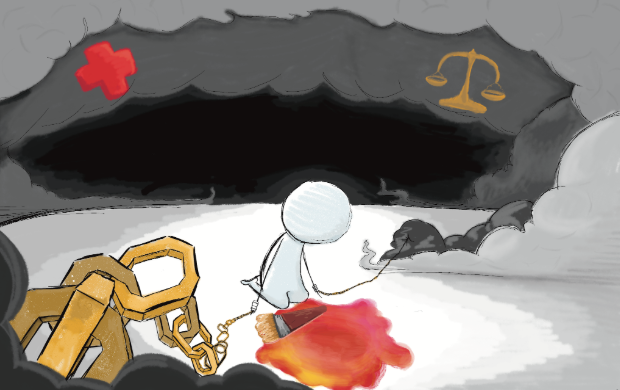
![Many teenagers are reluctant to receive professional support for mental health. There are various factors that play into teens not getting the help that they need. “[Teenagers] might feel that even though they're talking to someone, they still don't feel heard,” freshman Jaeda Gonzales said. “I've noticed that a lot of times when I try to talk to someone about my problems, it doesn't really click [with] them. [It’s] like they're making up their own story about my story in their head and they're just getting it all twisted.”](https://southwestshadow.com/wp-content/uploads/2026/05/mental-help-graphic.jpg)