
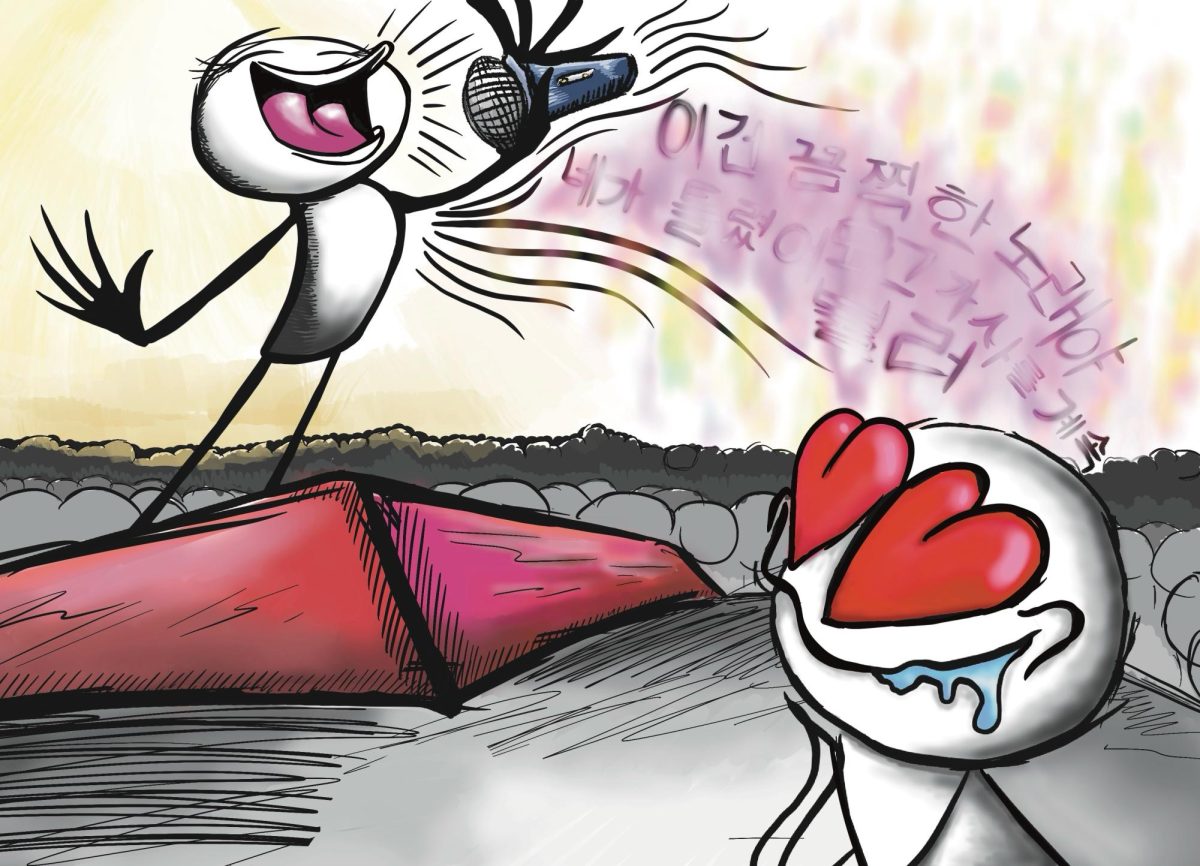
Millions of people are pressing play on songs they cannot translate, yet they still know exactly how those songs make them feel. With streaming platforms and social media opening doors to artists across the globe, audiences are forming emotional connections to songs long before they understand the lyrics. Nearly 40 percent of U.S. listeners regularly play music in a language other than English. From Latin pop to Afrobeats to K-pop, the “feeling” often comes first.
For many, that first connection has nothing to do with words. A beat hits, a voice rises, a melody lingers. Only later do some listeners search for translations, lyric videos, or fan explanations to understand what the song is saying. This creates a layered listening experience, one that begins with emotion and gradually builds toward understanding.
“Language doesn’t matter here, but still is deeply meaningful,” psychology teacher Benjamin Lacombe said. “Our core emotions can be triggered even when we don’t know the language because we can naturally identify body language and facial expressions.”
Over time, curiosity pulls listeners deeper. What starts as a catchy hook becomes a desire to understand the story behind the sound.
“It was my parents that got me into [Original Filipino Music],” freshman Arjan Lazlo said. “I’m Filipino myself, so I wanted to listen to more of my culture. The music was also played in the background of Filipino movies, which made the movie[s] more interesting.”
In addition, foreign music pulls listeners in through its aesthetic appeal, using visuals, rhythm, and performance to create an emotional response that transcends language.
“Personally for me, [my love for foreign music] came through K-Pop, or Korean Pop,” junior Aldrich Razon said. “A big part of it was the visuals, and how they were depicted on screen. Seeing those groups in those music videos was the main thing that shaped my understanding and resonated with me. With music, you don’t necessarily have to understand it to like it.”
Although these ideas challenge the idea that full comprehension is necessary, understanding the lyrics adds a greater layer of meaning to listeners.
“Lyrics are very important to me,” junior Jaidelyn Wiseman said. “While most of [the song] is about the beat, tempo, choreography and everything else, understanding the lyrics really gives insight on how the [artists] feel.”
Can It Be Translated? by Jon Victor Escala
True understanding does not happen alone. Online spaces have become gathering points where fans help one another make sense of the music they love. Platforms such as Weverse, Discord, and fan communities allow people to share translations, add cultural context, and discuss interpretations together. K-pop, in particular, thrives in these spaces, where global fans collaborate to turn individual reactions into shared meaning.
“You get to express yourself [and] talk to people about things you’re interested in,” Wiseman said. “I joined an Instagram group chat recently, and we’re all discussing music and having fun, as well as planning meetups at concerts.”
For some students, the discovery of diverse genres of music happens accidentally. They encounter songs without actively searching for it, often leading to a growing interest over time.
“A lot of the music that I [listen to but] don’t understand is Chinese R&B,” senior Ashton Yim said. “I’ll be listening in the car without knowing what [they’re saying] half of the time and going purely off of the vibe.”
At its heart, this trend is about shared experience. Across languages and cultures, music brings people together, allowing meaning to grow from feeling, curiosity, and connection rather than translation alone.
“You lose yourself in the crowd and you naturally release neurotransmitters and the music (at the high volumes) are causing sensory overloads,” Lacombe said. “You feel like these are ‘my people’ because you are sharing a common interest and experience.
![Many teenagers are reluctant to receive professional support for mental health. There are various factors that play into teens not getting the help that they need. “[Teenagers] might feel that even though they're talking to someone, they still don't feel heard,” freshman Jaeda Gonzales said. “I've noticed that a lot of times when I try to talk to someone about my problems, it doesn't really click [with] them. [It’s] like they're making up their own story about my story in their head and they're just getting it all twisted.”](https://southwestshadow.com/wp-content/uploads/2026/05/mental-help-graphic.jpg)