While scrolling on social media, I’ve noticed that whenever someone online posts about an interest that even slightly strays from the status quo, the comment section is filled with people ridiculing them, claiming that they’re only seeking attention or “trying to be different.” Seeing these types of comments has been frustrating to me because it seems entirely antithetical to society’s supposed push for people to “just be themselves.”
The Merriam-Webster dictionary defines “performative” as something “made or done for show.” Though this definition doesn’t imply anything inherently negative, people on social media have begun to use the word as an insult.
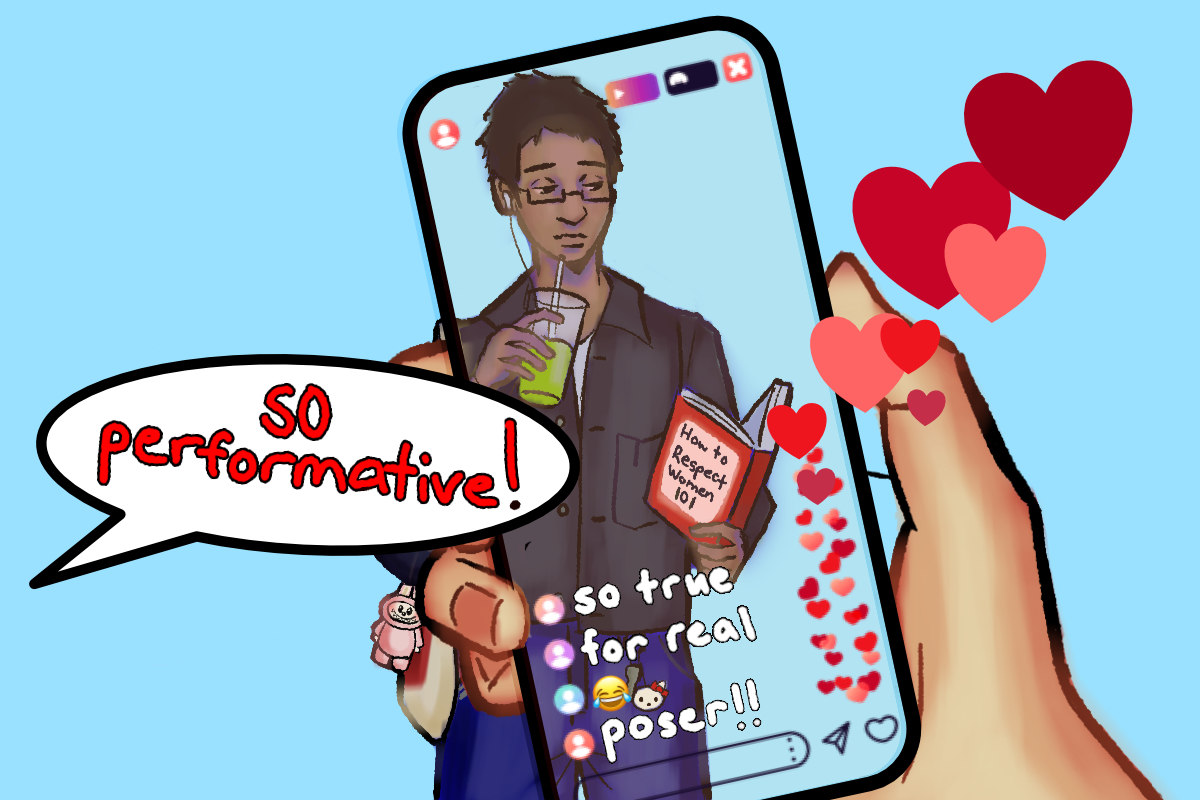
Google Trends reports that in 2025, the word “performative” reached an all-time high in interest. The surge in this search query is linked to the “performative male” trend that gained immense popularity on social media. The trend intended to call out a specific archetype of men who insincerely adopt interests that would pander to women.
Although the online trend of using the term “performative” originated as a way of critiquing people who put on superficial personas for external validation, it has quickly become another way to shame those who are different. Intentional or not, people have been disguising their mockery of others behind the justification of calling out those who are being “fake.” However, policing other people’s authenticity is just a cynical, self-serving act that only discourages people from truly being themselves.
The reality is all self-representation is performative by nature. According to the National Library of Medicine, the human tendency to imitate behavior is crucial in teaching skills required to function. Humans are social creatures who naturally observe and mirror the behaviors of others. Along with that, it is a well-known psychological occurrence that we, as humans, act differently depending on who we are interacting with. We might conduct ourselves more favorably in front of our parents, but be more talkative and carefree in front of our friends.
For this reason, the term “performative” shouldn’t exist with a negative connotation, as no one is purely original and we are all performing for others in some way. The term oversimplifies the complexity of humans and is merely a label people prescribe to others in order to feel better about themselves and to assert moral superiority for being more authentic.
With the word being misused to attack people’s characters and insist that they’re being someone that they’re not, people have started to change how they present themselves online. In an article from TIME, behavior scientist Dale Whelehan asserts that modern culture’s obsession with being “real” has shifted authenticity from being about who we actually are to how we are viewed by others, becoming something that we must constantly prove. He goes on to explain that, as a result, people have created what psychologists call their “false self,” a version of themselves that meets external expectations.
Authenticity has become a performance in itself, as people are expected to adjust their character to become more acceptable to the public. People are shamed for being performative, yet simultaneously, they are shamed for being their true selves. This, inevitably, creates a never-ending cycle of “performativism,” fueled by hate and a need to conform, that suppresses individuality and self-exploration. Thus, the constant threat of being labeled as “performative” only turns people away from partaking in interests where they could be told they’re being fake, even if they find genuine enjoyment in those things.
Some may argue that assessing the genuineness of someone’s interests helps weed out the people who are being deceitful. Take the term “performative activism,” for example. Social media users who use the term seek to stigmatize people who display support for a cause, only to make their image look better rather than to create genuine change. Though the use of this term is well-intentioned, it is unfortunately unrealistic.
Determining someone’s intentions through observation alone is not foolproof, as it is almost entirely subjective and only reflective of one’s personal judgments. This is not to mention the fact that people may not always show the full extent of their activism online. Misjudging genuine, albeit small-scale, advocacy for a cause as being calculated may inadvertently discourage participation from other people who aren’t as well-experienced in activism. People have no way of knowing what others are thinking or all of the inner workings of their lives and, therefore, have no concrete way of discerning if someone is truly who they portray themselves as in front of others.
The increased usage of the word “performative” reveals just how desperate we are, as humans, to constantly feel better than each other. But, at the end of the day, the world is a stage, and we are all performing. So, yes, the guy at your local coffee shop sipping a matcha latte while reading Jane Austen is “performative,” but so is everyone else. There is no true, non-performing version of ourselves that exists, so we should stop expecting others to act as though there were. If you are passionate about something that you may be mocked for, or you want to try something outside your comfort zone, don’t let narrow-minded social media users stop you from doing so. Doing what you love in spite of what others might say is ultimately the only way of truly living a fulfilling life.