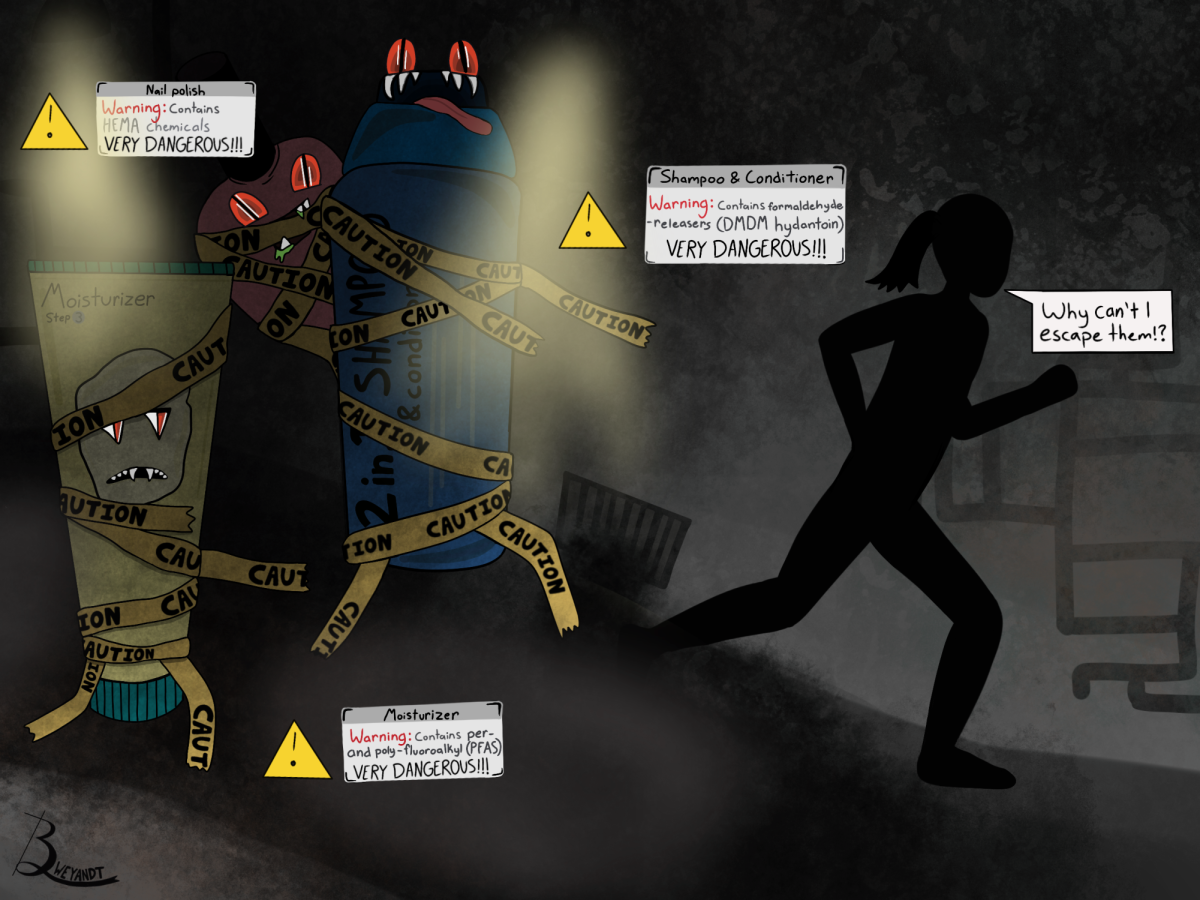
Imagine going to the salon to get your nails done, feeling excited to finally get the nails that you saw online. Instead, you end up coming home with an allergic reaction and chemical burns all around your cuticles. The ugly truth is that many cosmetic products contain harmful chemicals that can damage your skin and body with repeated exposure. The presence of these chemicals in cosmetic products show how brands are constantly putting their consumers’ health at risk.
Recently, I found out that one of my favorite gel polish brands, GAOY, contains the chemical 2-Hydroxyethyl Methacrylate, commonly known as “HEMA.” HEMA is a small monomer molecule that is found in many different gel polishes, liquid monomers and nail glues. When it touches skin for prolonged periods of time or in repetitive instances, it can cause allergic reactions that lead to contact dermatitis and chemical burns. According to the Environmental Working Group’s Skin Deep database, HEMA scores a five on their hazard scale, meaning it’s moderately hazardous. For comparison, a more commonly known and less hazardous chemical, isopropyl alcohol, scored a two on the scale.
The brand GAOY claims to be “HEMA-free”, which is why I put a lot of trust into them in the past. However, when you actually look at the ingredients list, it clearly states that it contains the chemical. A lot of companies like GAOY utilize these hollow marketing tactics, stating they don’t “intentionally” add ingredients with HEMA in it, which leaves the consumer entirely unaware that it is present in their product unless they find and read the ingredients.
While I was doing my research, I found that a lot of websites, like Ballpit Nails and Chaun Legend Nails do not even have an ingredients list present on their website. To find if there are allergens in your products, you have to go to third-party sites. This makes the consumer uninformed of the possible allergic reactions that products might cause. Other brands, like Kiara Sky, keep it out of the products they sell and even have an entire line free of harmful allergens, proving that it is possible for other companies.
Another harmful chemical that is in many cosmetic products is DMDM Hydantoin. This chemical is an antimicrobial formaldehyde-releaser preservative or, in short, a bacteria-killing chemical that slowly lets out formaldehyde. When exposed to such ingredients, you can develop an allergy to the substance itself or its by-product, formaldehyde. The ingredient is found in about 20% of cosmetic products, but more commonly in shampoos, conditioners, lotions and moisturizers. It is actually really hard to avoid this substance because it is pretty much everywhere. If you go to a public restroom and wash your hands, you are likely being exposed to the chemical.
The Environmental Working Group’s Skin Deep database gives DMDM Hydantoin a six on their hazard scale, making it only slightly more hazardous than HEMA. What makes this concerning for teenagers is how early on in life we are being exposed to these harsh chemicals. Many students, including me, use scented lotions, shampoos, and soaps daily that may include these chemical releasers. Such an early exposure can lead to allergies in the long run limiting the products students can use as they get older.
Finding out that products that I am regularly using are not as safe as I once thought has made me look more closely into what I use now. As a teenager, I think I am one of the biggest consumers of cosmetic products and yet I did not really know what I was putting onto my body prior. No one should have to do deep research to avoid using harmful chemicals. Companies should have a responsibility to protect their customers or at the very least, they need to be transparent with the substances they are putting into their products as well as put their ingredients onto their websites to ensure the safety of their customers. Health and safety should be the number one priority.