One day in fifth grade I was walking home after school with one of my only male friends at the time. Talking, we eventually get on the topic of me mainly hanging out with girls during activities like recess. He began to question my social circle and soon after asked me if I was gay. When I asked him why he would think I am, he said it was because of me mainly hanging out with girls, my voice being higher than the average male our age and the fact that I didn’t play any sports. At that moment, I didn’t know how to respond to him—I just knew that made me feel different. I was only in fifth grade, I didn’t know what being gay truly meant, I just knew if you were labeled “gay,” it meant something negative.
As life went on, the same event occurred throughout my years in school. Though I now identify as queer, it feels as if it’s automatically an assumption placed upon me from my peers, just because of my mannerisms and hobbies. It’s as if being queer introduces itself as me before I can introduce myself. Is it because my hair is long? Or because I smell like vanilla? Maybe because I listen to Billie Eilish?
It has always been awkward and confusing to me the factors people around me use to determine that I’m queer. There are many queer men in the world that are masculine, sometimes shocking the people around them when they discover such a masculine man isn’t straight. Although I am fine with being perceived as queer, society shouldn’t view assuming a man is queer simply because he is feminine acceptable.
It is not a new thing that society questions behaviors when they don’t fit stereotypes; in this case, gender roles and identity. For male stereotypes specifically, it’s showing interest in anything that’s feminine. The societal expectation placed upon men is that they are to be strictly masculine, meaning that they possess characteristics such as being emotionally isolated, a breadwinner, etc. Individuals who don’t follow these stereotypes, such as queer men, are often stereotyped as feminine. This is because they often go against the outdated stereotypes and expectations of masculinity, such as showing emotion, or not having a deep voice. Queer men are typically portrayed as feminine in the media, as femininity comes off as a “weak” trait compared to masculinity. This ultimately creates the stereotype that queer men are feminine, meaning that any man who shows interest in anything feminine becomes classified as “queer.”
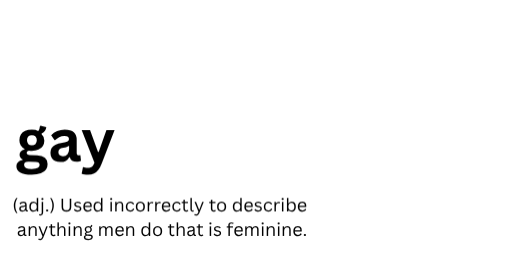
Labeling something as queer has been used and seen as an insult, as if the concept of being queer is alien or forbidden. This is very common amongst teenagers, primarily due to cliques and social media. Some use it to embarrass or even humiliate others. From fourth grade to now, I have always heard at least one of my male classmates get their sexual orientation questioned, or be called queer simply for demonstrating a “feminine behavior.” This ranges from having their nails painted, to listening to Sabrina Carpenter. They would either be labeled queer or been told what they were doing was queer, whether or not they actually possessed the title. Phrases like “that’s gay” turns queerness into a negative label. Many adolescents are taught from a young age, being called “gay” is something negative and should be avoided. The British Broadcasting Corporation reported that students as young as seven have been found to use homophobic language in school. When these ideologies get shared in school, they only become stronger.
Due to the negative connotation placed on the word “queer,” many men fabricate their public identity. This is commonly seen through a tactic called “mascing.” Mascing is the idea that men purposefully present strictly masculine ideals to diminish chances of being discriminated against and viewed as queer. Many feminine men commonly fall as victims of homophobia because rather than society rejecting “queerness” for what it is alone, it’s more setting strict boundaries for masculinity and calling out men when they don’t follow them. This gives the idea that identities must be fabricated as a way for these individuals to “stay safe.” I’ve seen situations with some of my close friends in which they are uncomfortable or afraid to share things, such as listening to Sabrina Carpenter because they fear being labeled queer. It is inane that societal standards regarding masculinity are so extremely fragile that straight men get labeled or viewed as queer for something as simple as listening to a female artist.
It is questionable to me that society has “accepted” discrimination. Discrimination against queer men doesn’t only affect them, but rather any man who is suspected to be queer. Men are vulnerable to facing harassment simply due to things like indulging in hobbies or activities seen to follow the queer stereotype. The point is, just because a man indulges in “feminine” activities, doesn’t mean they’re queer. In a world where we are constantly evolving, it’s disappointing that we are promoting outdated stereotypes towards being queer and attempting to regulate discrimination through social environments and social media. Being queer isn’t something that’s negative, continuing to amplify the stereotype will only continue to marginalize an already criticized and excluded community. As a society we must drop the outdated stereotype of toxic masculinity and allow the men around us to indulge in what they want to, not what they are expected to.